

A label does not change behavior. The design of a label does.
The EU just published three icons for labelling AI-generated content.The EU just published three icons for labelling AI-generated content. Looks like a compliance detail.

The European Commission just published three icons for labelling AI-generated content. Free, available in SVG and PNG, mandatory from 2 August 2026.
Looks like another compliance detail. But the EU, perhaps without fully intending to, ran a behavioral experiment. And the results should change how you think about transparency in your product.
Three icons, three situations
Here is what was actually created.
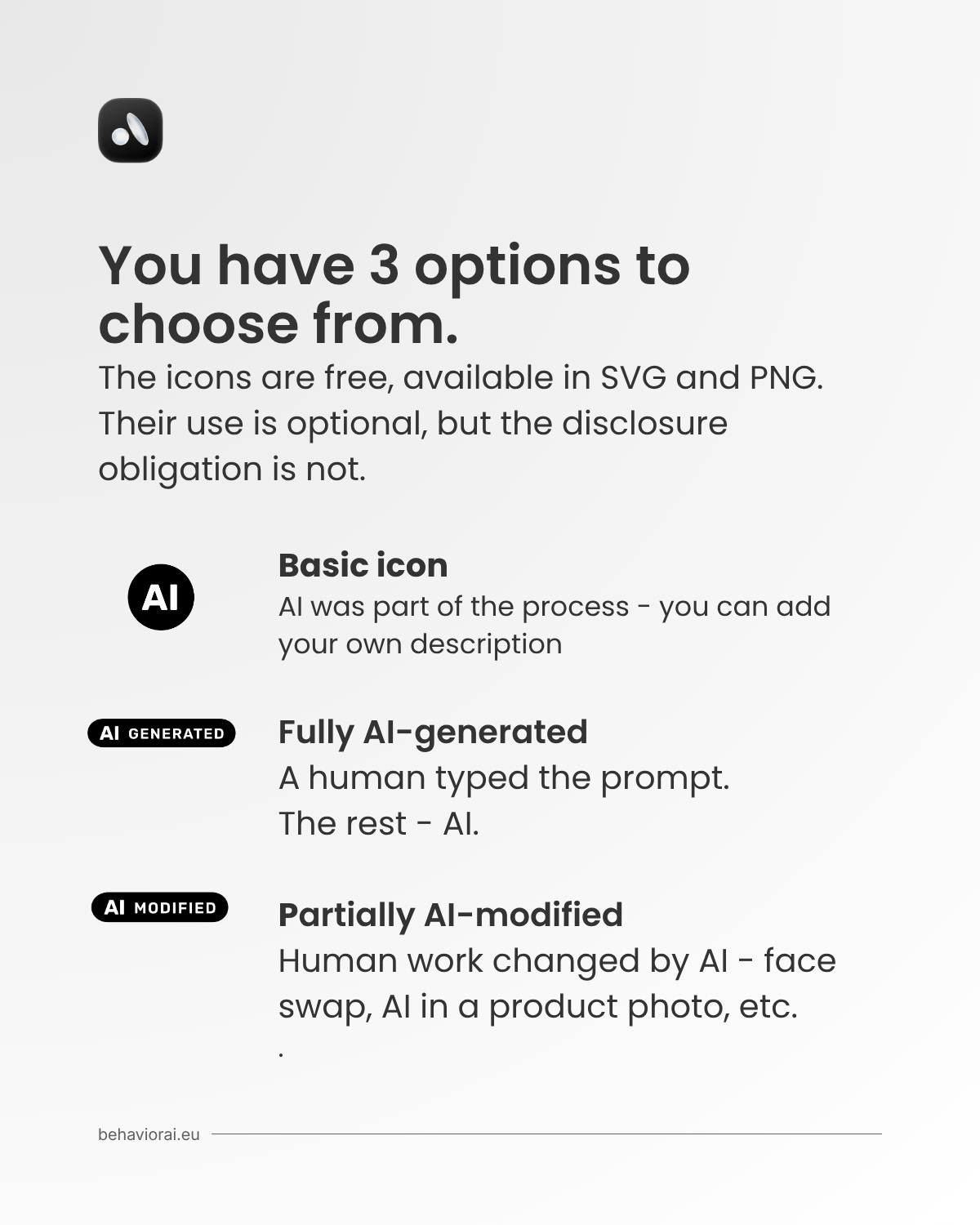
The basic icon is used whenever AI was involved in creating content in any way, without specifying how much.
The “fully AI-generated” icon applies when the entire piece was created by AI with no human elements beyond the prompt. Text, image, video, audio — all machine-made.
The “partially AI-modified” icon covers situations where someone started with real, human-made content and AI changed it somewhere along the way. A politician’s face placed on someone else’s body. An authentic voice saying words it never spoke.
The icons went through user testing. That is where things get interesting.
What the Commission found
During UX testing, the icon alone turned out to make almost no difference in how people perceived the content. Only when paired with a specific text label — for example, “voices generated by AI” — did something shift in how the audience interpreted what they were seeing. The Commission noted this officially and built the observation into the Code of Practice recommendations.
For anyone who works with behavioral product design, this is not a surprise. It is a confirmation of a pattern we have known about for decades from entirely different fields.
What labeling research has been telling us
Meta-analyses of tobacco warning studies show a consistent pattern: text-only labels increase knowledge but translate poorly into behavior change. Labels that trigger an emotional response are more effective at shifting intentions and actions. The effect is strongest at the level of attention and emotion, weaker at the level of intention, and weakest when it comes to actual behavior. Researchers have called this a “diminishing cascade of effects.”
Studies on AI labels applied to information content show results that may surprise you. A 2024 study found that labelling content as “AI-generated” reduced perceived accuracy even when the content was factually correct. People responded to the signal “AI” more than to the content itself. The label activated a distrust heuristic before the reader had even engaged with the text.
A longitudinal study from 2026 found that the effects of AI labels on social media are short-lived. After eighteen days, their influence on sharing behavior had dropped significantly.
Research on AI disclosure in advertising (Koning and Voorveld, 2025) shows that transparency does not automatically build trust. Telling people content was AI-generated can reduce trust in a brand even when the content itself is good. Transparency activates what researchers call persuasion knowledge: the reader starts looking for a hidden motive instead of evaluating the content. How a label is worded matters as much as whether it is present at all.
The AI invisibility effect
There is one more dimension of this story that rarely appears in regulatory discussions.
A study by Obada Krashan at Texas Tech University (2026) analyzed nearly 1.5 million mobile app reviews across 422 applications from the iOS App Store and Google Play, half of which featured AI capabilities. The finding is striking: only 11.9% of reviews mentioned AI, even though close to half of the applications studied had AI features.
In other words, most users had no idea they were using AI at all.
The study also revealed a paradox that Krashan called the AI Invisibility Effect. AI-featuring applications received lower ratings than traditional applications overall. But when the researchers controlled for whether users had actually mentioned AI in their reviews, that relationship reversed. The negative ratings did not come from AI being present. They came from users becoming aware of it.
AI operating below the threshold of user awareness was evaluated differently than AI the user had consciously identified. And not in favor of the latter.
This is the invisible layer in action.
The layer that regulation does not reach
The EU AI Act regulates the structure of the system: what must be labelled, when, and by whom. That is necessary and valuable work.
But there is a space that regulation does not touch, and that space is where the real question lives: whether the label actually changes anything in the mind of the person who sees it.
This is the space between the interface and the user’s head. Not what appears on the screen, but what happens in the brain of the person looking at it.
Several mechanisms operate in this space that matter directly to product designers.
Most perception of digital content runs through fast, automatic processing — what Kahneman called System 1. A small icon in the corner of the screen, without context, will most likely be ignored. Not because the user rejects it, but because they never truly process it. For a label to reach conscious evaluation, it needs to be prominent enough, placed correctly, and appear at the right moment.
Timing relative to the decision matters. A label works best when it appears at the point where the user is actively forming a judgment about the content. A warning shown after the fact, or before the person has engaged with the content at all, has a much weaker effect.
Labels that trigger an emotional response are far more effective than purely informational ones. An EU icon is an informational signal. The sentence “this voice never existed” is an emotional signal. The difference in impact is substantial.
The transparency paradox is real. Krashan’s data shows that users who do not know they are using AI evaluate a product differently from those who do. Not always in favor of awareness. This is not an argument for hiding AI. It is an argument for designing the moment and manner of disclosure very deliberately, because that design has real consequences for how users relate to your product.
What this means if you build AI products
If your product will need to label AI content from 2 August 2026, you have two paths.
You can treat it as a formal requirement: add the icon somewhere in the interface, update the compliance documentation, and move on.
Or you can treat it as a behavioral design problem.
A few questions worth working through before you start:
Where is your user’s decision moment? A label only does something useful if it appears before the user has already formed a judgment about the content. If the icon shows up below the fold, it is already too late.
Does your label actually say something? An icon without text is a signal without meaning for most users. What sentence, paired with the icon, would actually shift how someone reads what they are seeing?
What does your user not know that they should? “AI” as a label is too abstract to change how someone processes content. “This video depicts an event that never happened” is concrete enough to make a difference.
Does transparency help or hurt trust in your specific context? Krashan’s research shows this depends on product category. AI assistants with visible disclosure were rated more positively. Entertainment apps were rated less positively. It is worth testing before you ship.
How does the label design affect the overall product experience? A label that feels intrusive trains users to ignore it. A label that feels genuinely informative builds a habit of critical engagement with the content.
A closing thought
The EU created a tool. A considered one, tested with real users, grounded in real observations from UX testing.
But a tool is only a starting point. The space between what a regulation requires and what actually happens in a user’s mind is the invisible layer. That space belongs to designers, not lawyers.
Compliance tells you what you have to do. Behavioral design tells you how to do it in a way that actually matters.
EU icons for download (SVG, PNG): digital-strategy.ec.europa.eu
Code of Practice: link.europa.eu/pKjVVB
Krashan study: arxiv.org/abs/2601.00579
Kasia Szczesna works on the behavioral design of AI products - the space between the interface and the human mind. More at kasiaszczesna.pl and behaviorai.eu